publications
Papers and bioRiv.
2026
- BMC
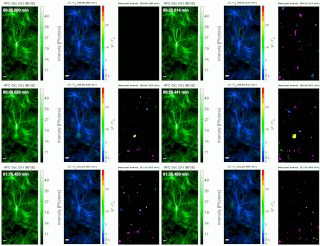 LPS-induced inflammation differentially affects endogenous Ca2⁺ activity in mouse and human iPSC-derived astrocytesFranziska E Müller, Flavian Ivanov, Anne-Catharine Studt, and 8 more authorsMolecular Medicine, 2026
 - bioRxiv
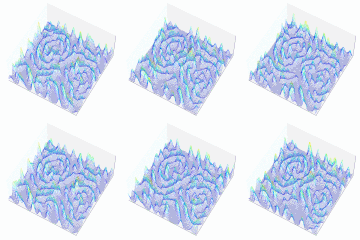 Cortical Field Model of Complex Spiral Traveling WavesGhanendra SinghbioRxiv, 2026
Complex spiral traveling waves observed experimentally occur across the cortex. The underlying mechanisms responsible for generating such mesoscopic activity are not well understood. Understanding how local cortical neuronal populations interact to produce emergent spiral dynamics during cognitive processing remains unknown. Therefore, to bridge this gap, a spatiotemporal cortical field rate model of local cortical circuits, composed of excitatory and three distinct time-scale inhibitory populations, is proposed. This model is extended to a two-dimensional cortical sheet, consisting of both nonlinear local interactions and diffusive global coupling, with distance-dependent axonal delays. Simulation results indicate mixed-mode oscillations occur in the local circuits, which may represent the coexistence of multiple rhythms and show the emergence of complex dynamics, such as rotating spirals with annihilation events. Spiral waves differentially respond to the strength of the grating input stimulus and exhibit working memory-like characteristics. Also hypothesize that local patterns, such as planar, source, sink, or concentric across the cortex, might be an inherent integral part of the spiral state dynamics.
2023
- bioRxiv
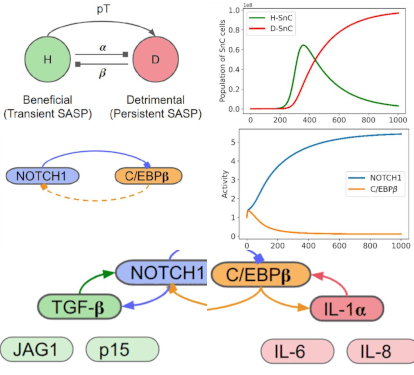 Senescent Subtypes Transition ModelGhanendra SinghbioRxiv, 2023
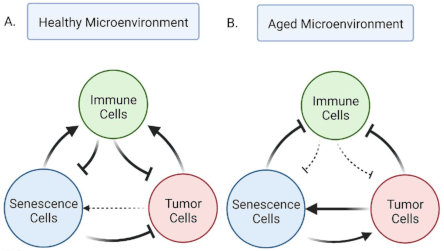
Senescence has both beneficial and detrimental roles across the tissues over time. This dual nature is mediated by the senescence-associated secretory phenotype (SASP). Still, transient and persistent SASP secretion is poorly understood. There are some unknown mechanisms through which phenotypic transition takes place from beneficial helper (H) senescent cells to deleterious (D) senescent cell states. NOTCH1 is suggested to mediate switching between the different SASP secretomes. NOTCH1 also suppresses a transcription factor C/EBPβ during the SASP secretion. Therefore, a hypothesis is proposed about the existence of negative feedback from C/EBPβ to NOTCH1 together forming a senescence-switching circuit that might be mediating this phenotypic transition at the molecular level. Using a population dynamics model with competitive interaction to decipher the underlying transition mechanism between the senescent cell subtypes and a mechanistic model to explain the underlying molecular mechanisms of NOTCH1 signaling in modulating the two waves of SASP secretion. By designing effective senescence therapies with selective removal of deleterious senescent cells and maintaining sufficient helper senescent cells can enhance health span and reduce age-related effects.
2022
- bioRxiv
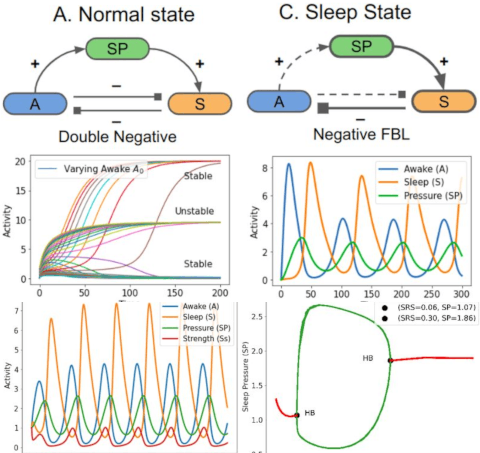 Astrocytic Sleep Homeostasis ModelGhanendra SinghbioRxiv, 2022
Sleep awake cycle is critical for cognitive and functional abilities. Conventional sleep homeostasis mechanisms are neuronal in nature and recent views indicate glial regulation of the sleep-wake process. Mechanisms of homeostatic regulation of sleep remain to be understood. A simplified astrocytic sleep-awake homeostasis mathematical model with sleep pressure and synaptic strength dynamics is proposed using feedback control loops. The model provides insights into the emergence of two discrete states through sleep and awake promoting neuronal populations giving rise to a homeostatic process S and oscillatory process C is regulated by astrocytic sleep pressure. It also explains the variations seen in synaptic strength dynamics during sleep and awake states.
@article{singh2022astrocytic, title = {Astrocytic Sleep Homeostasis Model}, author = {Singh, Ghanendra}, doi = {10.1101/2022.10.23.513380}, journal = {bioRxiv}, pages = {2022--10}, year = {2022}, publisher = {Cold Spring Harbor Laboratory}, } - bioRxiv
2021
- bioRxiv
 Population dynamics of hybrid state during adaptive therapy in cancerGhanendra SinghbioRxiv, 2021
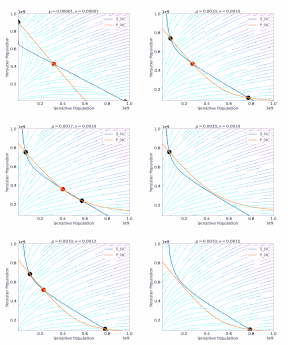
Drug resistance emerges due to drug-induced phenotypic switching of drug-sensitive to drug-resistant subpopulations in cancer during therapy. Existing models indicate the competitive advantage of sensitive over resistant population to regulate tumor and reducing the treatment cost with increased time to progression of tumor ultimately benefiting the patient in a clinical setting. Here, we present a Lotka Volterra (LV) based population dynamics (PD) model of the drug-sensitive, drug-resistant, and transient drug-hybrid state along with phenotypic switching during adaptive therapy based on a simple cancer biomarker (CB) to decide the adaptive therapy dosage to regulate cancer. We identified that the strength of intra competition along with phenotypic switching parameters is crucial to mediate the effectiveness of adaptive therapy and also investigated the significance of the initial fraction of subpopulations on AT. We hypothesize and predict the dynamics of drug-induced transient hybrid state playing a key role in the cancer cells undergoing metastasis.
- bioRxiv
 Mechanistic Model of Replication Fork Progression in YeastGhanendra SinghbioRxiv, 2021
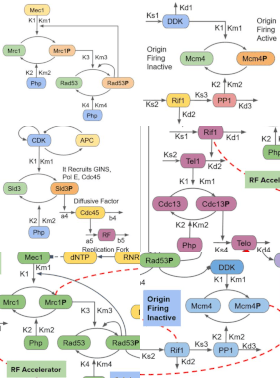
Replication fork progression complex plays an essential role during DNA replication. It travels along with the DNA with a particular speed called replication fork speed. Faithful duplication of the genome requires strict control over replication fork speed. Both acceleration and pausing mechanisms of the replication fork complex are regulated at the molecular level. Based on the experimental evidence, DNA replicates faster in normal cells than cancer cells, whereas cancer cells duplicate themselves more quickly than normal cells. Then in principle, accelerating the replication fork complex in cancer cells beyond a specific threshold speed limit can cause DNA damage and plausibly kill them. A modular mathematical model is proposed to explain the dynamics of replication fork control during DNA replication using the underlying molecular mechanisms in yeast which can extend to the mammalian system in the future.
- bioRxiv
 Mechanistic Model of Telomere Length Homeostasis in YeastGhanendra Singh and K SrirambioRxiv, 2021
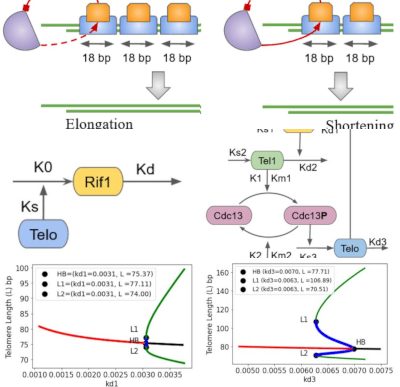
Cells maintain homeostatic telomere length, and this homeostatic disruption leads to various types of diseases. Presently, it is not clear how telomeres achieve homeostasis. One of the prevailing hypotheses is a protein-counting model with a built-in sensor mechanism that counts proteins that directly regulate the telomeric length. However, it does not explain telomere length regulation at the mechanistic level. Here, we present a mathematical model based on the underlying molecular mechanisms of length regulation needed to establish telomere length homeostasis in yeast. We perform both deterministic and stochastic simulations to validate the models with the experimental data of Teixeira et al., rate-balance plot, and phase plane analysis to understand the nature of dynamics exhibited by the models. For global analysis, we constructed bifurcation diagrams. The model explains the role of negative and positive feedback loops and a delay between telomerase and telomere-bound proteins, leading to oscillations in telomere length. We map these in-silico results to Teixeira’s proposition of telomeres making a transition between extendible and non-extendible states.